

Shopify Integration


Install Shopify integration
For vendors handling their products and orders on Shopify WITHOUT using Shopify Collective: you can use the Common Goods Seller sales channel to have real-time integration with Common Goods with no effort.
Integration scope
- ✅ Easy install with Common Goods Seller
- ✅ Product synchronization
- ✅ Order synchronization
- ✅ Fulfillment status
- ✅ Tracking synchronization
Speed
The integration is optimized for performance:
| Operation | Speed |
|---|---|
| First import | ~50 products/min |
| First import (Shopify Plus) | ~180 products/min |
| Product update → Marketplace | 0.30s |
| Order creation | 0.22s |
| Tracking update | 0.82s |
| Price/stock update | 0.31s |
| Content update (images, description) | 1.4s-3.2s |
Common Goods - Garnet Seller
Common Goods - Garnet Seller integrates gracefully with other applications. So if the vendor uses fulfillment or product management apps, it will still work.
Common Goods - Garnet Seller allows synchronizing seamlessly with Common Goods Marketplace the following:
- Orders: when the marketplace receives an order, it is forwarded to the vendor.
- Products: when the vendor updates a product, it is reflected on Garnet and, if approved, on Shopify.
- Trackings: when the vendor fulfills an order, the marketplace receives the tracking.
Shopify product synchronization
Synchronization delay: real-time
What is synchronized?
With the Shopify integration, the following information is imported from the vendor's Shopify to the marketplace:
- product title and SEO title,
- product description and SEO description,
- product and variant images,
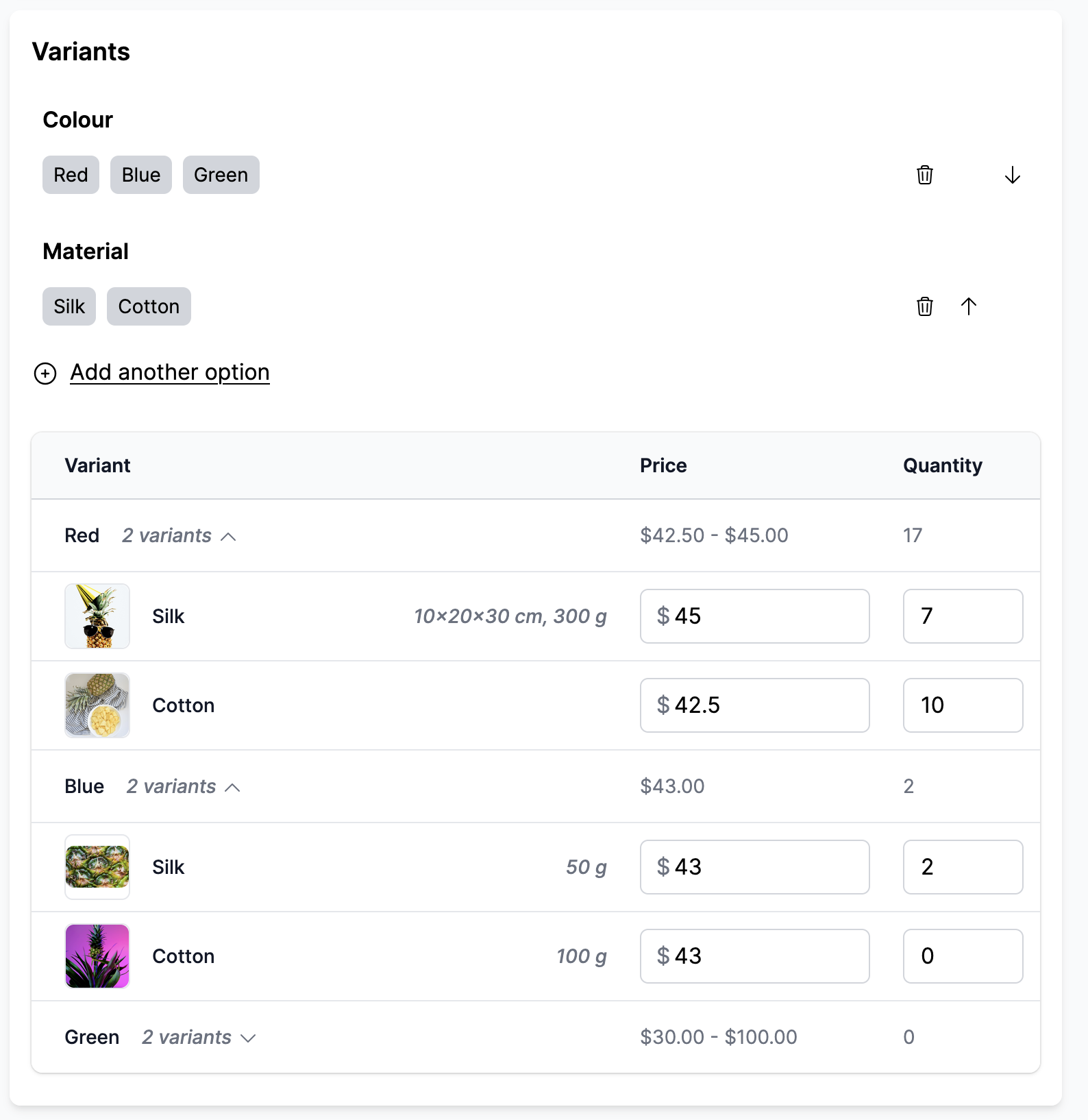
- variants price, stock and stock policy,
- product variations.
Which products are synchronized?
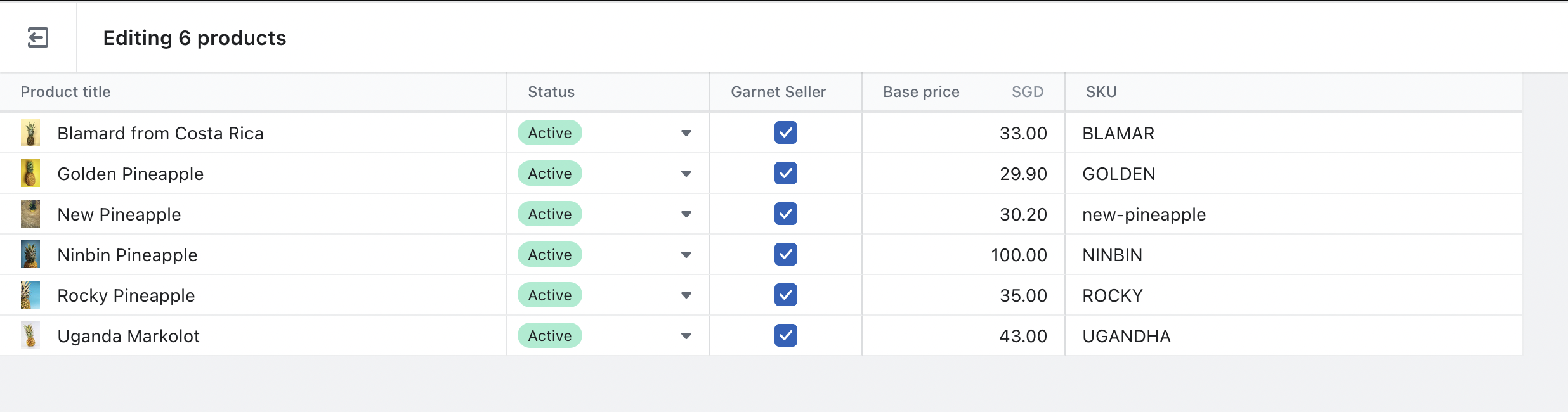
The vendor decides which products to synchronize. The vendor can access the products available on the marketplace following Shopify > Sales channels > Garnet Seller > Manage availability.
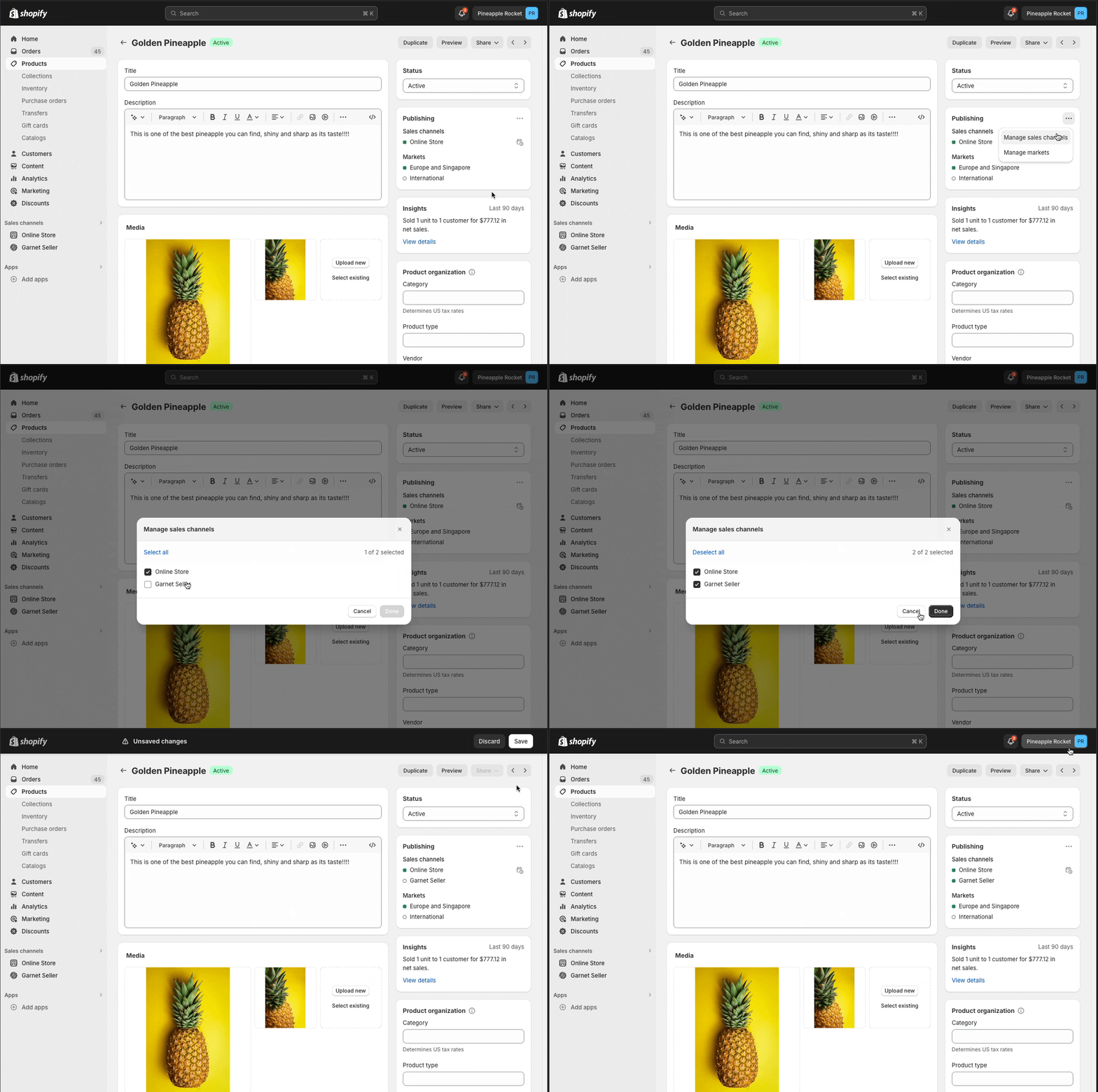
Alternatively, a vendor can publish individual products on the marketplace by clicking Publishing > Sales channel > Garnet Seller:
Price and compare price transformation
The vendor can set up the price transformations directly in their Shopify app.
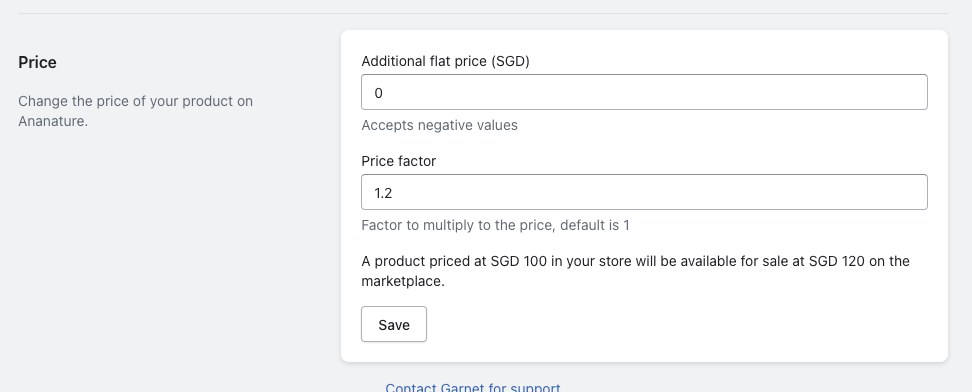
Vendor update price view on Garnet Seller
Once changed, it can take up to 10 minutes to update all prices.
Manage different currencies
Garnet converts no currency during a price sync: the marketplace price is the seller price times the price multiplier. When the seller connects a store that trades in another currency than the marketplace, Garnet sets that multiplier to the live exchange rate, provided it is still at its default of 1. The rate is a snapshot taken at connection time, so adjust the multiplier when the exchange rate moves, or to add a margin.
For instance, if the seller store is in EUR and the marketplace store is in USD and the exchange rate is 1 EUR = 1.078 USD, the multiplier is 1.078.
Prices are always stored in the marketplace currency.
Untracked inventory
If the vendor does not track the inventory of their product, they will be marked as untracked inventory on Common Goods and will not be approved for sale.
Sanitized product description
For privacy reasons, all <scripts> and <iframe> tags are removed from the product description.
Updates and approval
Only price/stock updates will be propagated automatically.
When another visible field is edited (title, description, images or compare price), the app will generate a new submission that needs to be approved by the marketplace.
Product deletion
When a product is deleted or removed from the Common Goods | Garnet Seller sales channel, the linked product is also deleted on the marketplace both as a submission, and as a product.
Metafields synchronization
By default, Common Goods does not provide metafield synchronization.
Variant image synchronization
The Shopify integration properly synchronises the variant image. If the Do not synchronize content is turned off, the image will only be added once and never overriden.
Advanced integration settings
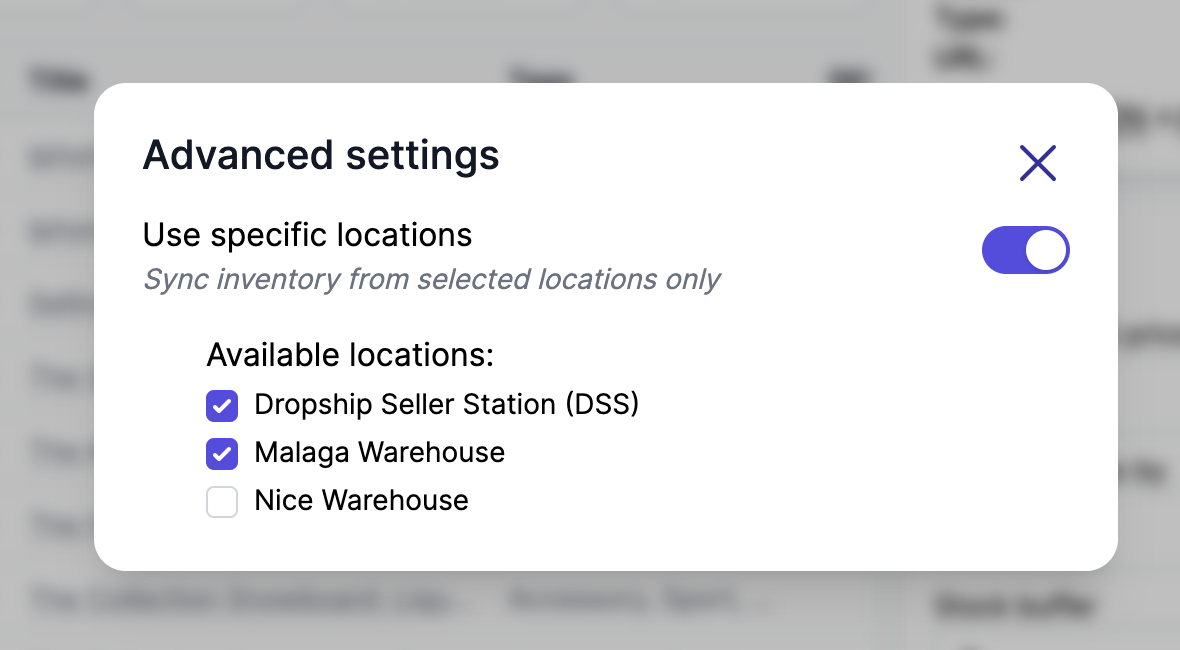
Location selection
Vendors with multiple Shopify locations can choose which locations to sync inventory from. Enable "Use specific locations" to pick individual warehouses or fulfillment centers. If not selected, inventory is synced from all locations by default.
On this Page
- Install Shopify integration
- Shopify product synchronization
- Shopify order synchronisation
- Shopify tracking synchronisation


